



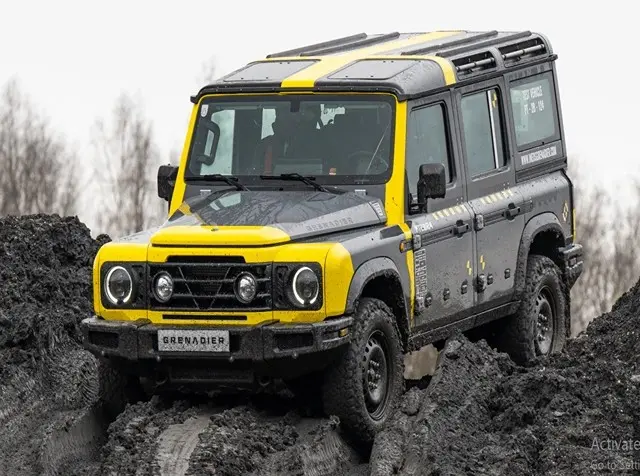
Sir Jim Ratcliffe has entered the race to replace the British Army’s ageing Land Rover fleet with his Ineos Grenadier 4x4, setting up a major showdown with long-established rival Jaguar Land Rover and other defence manufacturers. Reports from The Telegraph, The Times, and The Sun said Ratcliffe’s company is preparing a formal bid for a Ministry of Defence contract initially valued at around £900 million.
The contract is part of the British Army’s Light Mobility Vehicle programme, which aims to replace thousands of Land Rovers that have been used by British forces for more than 70 years. The Ministry of Defence plans to order roughly 3,000 vehicles initially, with the total fleet potentially expanding to 7,000 vehicles by 2030.
Ratcliffe’s Ineos Grenadier was specifically designed as a rugged off-road utility vehicle inspired by the original Land Rover Defender after Ratcliffe failed to acquire the rights to continue producing the old Defender model. The vehicle has since become one of Ineos Automotive’s flagship products and is now being marketed for military and special-forces applications across Europe.
The Telegraph reported that Ineos has already held discussions with the Ministry of Defence ahead of the tender process. Initial bids are expected to be submitted this week as the government begins evaluating replacement options for the Army’s current fleet.
The move represents one of the most ambitious expansion efforts yet for Ratcliffe’s automotive business, which has attempted to position itself as a modern successor to traditional British off-road vehicle manufacturing.
Competition Intensifies Over £900 Million Defence Contract
The competition to replace the Army’s Land Rovers is expected to become one of the most significant British defence procurement battles in years. Ratcliffe’s Ineos Grenadier will face competition from several major defence and automotive companies, including Jaguar Land Rover, BAE Systems, Supacat, and Babcock.
Jaguar Land Rover is reportedly preparing a military version of its modern Defender SUV as part of its bid to retain its historic relationship with the British military. Land Rover vehicles have been closely associated with the British Army since the late 1940s and have served in conflicts around the world.
Other competitors are also entering the contest with heavily modified off-road vehicles designed specifically for military mobility and transport operations. BAE Systems is reportedly working alongside General Motors, while Supacat and Babcock are expected to submit proposals based on adapted Toyota Hilux vehicles.
The Ministry of Defence said the new fleet must provide “light, dependable, and flexible mobility” capable of operating in modern combat and support environments. Reports suggested the military wants vehicles that are easier to maintain, more adaptable, and better suited to future battlefield requirements than the ageing Land Rover fleet.
The first replacement vehicles are expected to enter service around 2030 as the Army gradually phases out the remaining Land Rovers still operating across multiple units. According to defence reports, roughly 5,000 Land Rovers remain in British military service today.
Industry analysts said winning the contract would provide a major boost not only financially but also symbolically because of the historic role Land Rovers have played within the British armed forces.
Grenadier’s Origins Tied Closely to Old Defender Legacy
The Ineos Grenadier’s entire identity has been closely connected to the original Land Rover Defender from the beginning. Sir Jim Ratcliffe launched the project after reportedly becoming frustrated that Jaguar Land Rover had stopped production of the classic Defender model in 2016.
Ratcliffe originally attempted to buy the tooling and rights to continue producing the old Defender design but was unsuccessful. He then decided to create a completely new off-road vehicle inspired by the Defender’s rugged styling and utilitarian approach.
The result was the Grenadier, a boxy off-road SUV designed primarily for durability, heavy-duty use, and off-road capability rather than luxury or urban driving. The vehicle uses BMW-supplied engines and is built at a factory near the French-German border after Ineos acquired a former Mercedes-Benz Smart plant in Hambach, France.
The similarities between the Grenadier and the classic Defender eventually led to a legal dispute with Jaguar Land Rover. JLR accused Ineos of copying the Defender’s design, but courts ultimately ruled that the Grenadier did not infringe Land Rover’s intellectual property rights.
Ineos executives have continued marketing the Grenadier as a practical and highly capable off-road vehicle suitable for expedition, industrial, and military environments. Company officials told media outlets the Grenadier’s simplicity and durability make it especially appropriate for defence applications.
The military contract therefore carries extra symbolic importance because Ratcliffe’s vehicle was effectively created as a spiritual successor to the older Land Rover Defender now being retired by the Army.
British Army Begins Transition Away From Historic Land Rovers
The Ministry of Defence formally announced earlier this year that the British Army had begun retiring its long-serving Land Rover fleet after more than seven decades of military service. Government officials described the decision as the beginning of a major modernization effort for Army mobility vehicles.
Land Rovers have played a central role in British military operations since the post-World War II era and became one of the most recognizable military vehicles associated with the UK armed forces. They were widely used in combat zones, logistics operations, reconnaissance missions, and troop transport across multiple generations of military campaigns.
However, defence officials said the ageing fleet is becoming increasingly difficult and expensive to maintain. Reports indicated that repeated delays and restructuring inside Britain’s military vehicle replacement programme created pressure to finally move forward with a modern replacement system.
The Ministry of Defence said future mobility vehicles must meet modern battlefield demands involving advanced communications, modular equipment, improved protection, and better adaptability for different mission types.
Road & Track reported that while Land Rovers had already been supplemented in some specialised roles by newer military vehicles, they still remain important for light transport and utility operations throughout the armed forces.
The replacement programme is therefore viewed as one of the most significant modernization efforts involving British Army ground vehicles in recent years. Defence analysts said the final winner of the contract will likely shape British military mobility operations for decades.